
Accelerating impact



Accelerating impact in young people's mental health
Turning growing understanding into practical action
Research has greatly advanced our understanding of young people’s mental health. We know more than ever about the biological, psychological and social factors that influence mental health and research continues to reveal opportunities to prevent mental ill health, identify it earlier and develop more effective support, management and treatment.
But evidence alone does not create change.
Promising discoveries can take years – sometimes decades – to improve people’s lives. New ideas may struggle to progress beyond early development and even effective approaches can encounter barriers to adoption, sustained use and scale.
YPMH works to close this gap by accelerating and improving the translation of research and evidence into practical, equitable and scalable action. Through structured engagement, analysis and prioritisation, we help collaborators combine evidence, expertise and lived experience, develop shared understanding, identify and assess promising opportunities, advance potential solutions and support their implementation.
Our Understand : Innovate : Implement methodology helps accelerate the translation of research into more effective and usable innovations that can be applied at scale.
Learn more about each stage:
Why promising research does not automatically create change
Improving young people’s mental health requires more than generating evidence. It means addressing connected challenges across understanding, innovation, implementation and the wider systems in which people live and receive support.
Complex and connected causes
Mental health is influenced by interacting biological, psychological and social factors from early life onwards. Genetics, relationships, experiences, physical health, food, sleep, activity and wider social and environmental conditions can all contribute.
Understanding how these factors interact is essential to identifying where and how intervention may be most effective.
Different needs and intervention opportunities
Young people may experience similar symptoms for different reasons and respond differently to the same intervention. Greater precision is therefore needed in understanding how and why conditions develop, identifying the key processes contributing to mental ill health and opportunities to prevent or reduce them, and determining which approaches are most likely to benefit particular people in particular circumstances.
Potential interventions range from prevention and earlier identification to diagnosis, personalised management and treatment. They may focus on individuals and families, services and organisations, communities, policy or wider systems.
A difficult journey from research to practice
Turning understanding into implementation-ready innovations involves several stages: identifying unmet needs, generating ideas, selecting priorities, designing for user acceptability and ‘implementability’, developing and testing solutions and establishing evidence of their value.
Promising ideas can lose momentum between these stages. Innovations may fail to reflect the needs of intended users or the requirements of the organisations expected to adopt them. Funding, regulation, usability, skills, infrastructure and ownership can all affect whether an idea progresses.
Barriers to adoption, sustained use and scale
An effective innovation will not improve outcomes unless people and organisations can use and sustain it. Successful implementation may require changes in behaviour, working practices, resources, capabilities, operating models, commissioning, regulation or policy.
These requirements are often considered too late. Addressing them from the outset makes it more likely that promising solutions can be adopted, delivered effectively and extended to benefit more people.
Understand : Innovate : Implement
A structured methodology for accelerating change
Understanding a challenge, developing promising solutions and implementing them successfully are often treated as separate activities. This can produce research that is difficult to translate, innovations that do not meet real-world requirements and effective approaches that struggle to achieve sustained or widespread use.
YPMH’s Understand : Innovate : Implement methodology connects these activities through a structured, collaborative and iterative process.
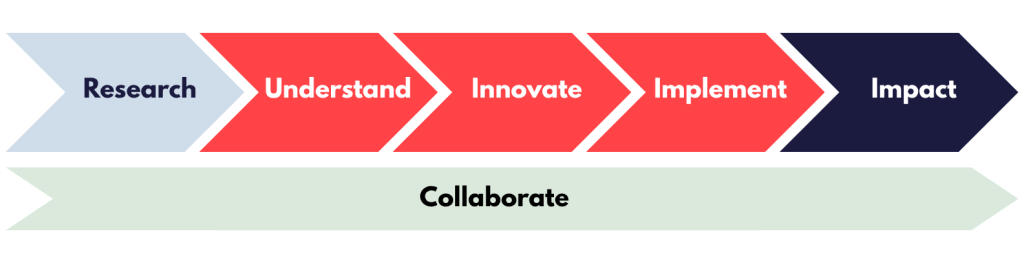
By connecting evidence, expertise, lived experience and action, the methodology helps collaborators identify where change is most needed, develop solutions with the potential to make a meaningful difference and create the conditions required for successful implementation.
Understand
Developing a precise and shared understanding of the challenge
Effective action begins with understanding how mental health conditions develop and opportunities to address key factors and mechanisms, the needs to be addressed, the outcomes that matter and the factors influencing them.
We bring together research evidence, lived experience, practice and system knowledge to understand:
- the biological, psychological and social factors and mechanisms contributing to mental ill health
- opportunities for prevention, earlier identification, diagnosis, personalised management and treatment
- why the responses of people with similar symptoms to interventions may vary
- the needs and experiences of children, young people and families and of the organisations they engage with, and that support them
- the environments and systems that can enable or inhibit improved outcomes
We collaborate with researchers, practitioners, providers, commissioners and others able to contribute evidence, expertise and knowledge. We engage young people, families and people with lived experience through consultations and other structured activities so that their needs, perspectives, priorities and experiences inform the shared understanding of the challenge. Structured analysis and engagement help collaborators examine evidence from different perspectives, identify important gaps and develop a shared understanding.
This creates a stronger foundation for determining where innovation and intervention could make the biggest difference.
Innovate
Turning understanding into promising solutions
Innovation begins with a clear understanding of how mental health conditions develop and the opportunities to address key risk factors and mechanisms, a sound understanding of unmet needs and of the outcomes that potential solutions must achieve.
We work with researchers, innovators, practitioners, delivery organisations, policymakers, funders and others able to help develop, fund, adopt or implement change to:
- identify promising opportunities for intervention
- define the needs, outcomes and requirements that potential solutions should address
- generate and assess possible approaches
- assess opportunities according to the significance of the unmet need, their potential impact and feasibility
- develop portfolios of near-, medium- and longer-term innovations
- ensure that the needs and perspectives of intended users inform development, alongside the requirements of implementers and decision-makers
- support promising solutions as they progress through development and testing towards adoption and scale
Considering user needs, adoption requirements and system constraints from the outset helps prevent promising ideas from becoming disconnected from the settings in which they will be used.
YPMH has developed and refined Understand : Innovate : Implement over seven years through long-standing collaboration with researchers at the University of Cambridge’s Institute for Manufacturing and with IfM Engage, the Institute’s knowledge-transfer company. This collaboration has drawn on their internationally recognised expertise in innovation management, roadmapping and innovation systems and has been particularly important to the development of the Innovate component.
Implement
Enabling adoption, sustained use and scale
Promising innovations improve outcomes only when people and organisations can adopt, deliver and sustain them.
Implementation requirements should therefore inform an innovation from the outset, rather than being considered only after its development has been completed.
Depending on the intervention and context, we help collaborators:
- understand the needs of intended users and implementers
- identify the behaviours, capabilities, resources and infrastructure required
- involve the people and organisations whose decisions will affect implementation
- design workable delivery and operating models
- address organisational, financial, regulatory and system barriers
- test, evaluate and refine approaches in real-world settings
- plan for sustained use, wider adoption and scale
Learning from implementation also strengthens understanding and informs further innovation. Understand : Innovate : Implement is therefore an iterative process in which evidence, action and learning continually influence one another.
The methodology in practice
The Mental Health Catalyst
The Mental Health Catalyst is a major international initiative applying an adaptation of Understand : Innovate : Implement to help accelerate the identification, development and adoption of new and better interventions for clinically significant depressed mood – encompassing depressive disorders and depressive symptoms occurring in anxiety disorders and bipolar disorder.
Commissioned by Wellcome and led by IfM Engage, the Institute for Manufacturing’s knowledge-transfer company, the Catalyst brings together expertise from mental health research, innovation and implementation. Generation Mental Health leads structured engagement with people with lived experience so that their perspectives inform the programme’s design, activities and outputs.
The Catalyst’s work connects several activities that are often undertaken separately:
- synthesising evidence to develop a more integrated understanding of clinically depressed mood
- identifying and prioritising promising opportunities for intervention
- examining the environments and infrastructure that enable or inhibit the progression of interventions
- developing shared roadmaps to coordinate action and investment
- supporting collaboration across disciplines, sectors and countries
As a founding collaborator, YPMH has played a key role in adapting Understand : Innovate : Implement for the Catalyst and continues to contribute to the development and application of the methods used to translate research and evidence into innovation and implementation.
Within the Catalyst, the adapted methodology connects integrated understanding of depressed mood, the identification and prioritisation of intervention opportunities, analysis of environments and infrastructure and roadmapping towards validation, adoption and scale.
Accelerating impact requires collaboration and engagement
No single organisation can bridge the gap between research and real-world impact alone.
We collaborate with researchers, innovators, practitioners, educators, health and social care organisations, policymakers, funders and others able to help develop, fund, adopt or implement change. We engage young people, families and people with lived experience so that their needs, perspectives, priorities and experiences inform the work throughout.
We welcome opportunities to work with people and organisations that share our ambition to prevent and reduce mental ill health and improve the support available to children and young people.