African American woman stressed at office desk with colleagues nearby, conveying workplace pressure.

Stress, cortisol and mental health

What’s really going on in your body, and what you can do about it

Cortisol is commonly described as the body’s “stress hormone”, often in a negative way. But cortisol is not inherently harmful. It plays a vital role in helping the body respond to challenges, wake up in the morning, stay alert and manage energy throughout the day. Short-term increases in cortisol are normal and a necessary part of the body’s stress response.

The issue arises when stress becomes chronic (long-term) rather than temporary. When stress continues for weeks or months, it can begin to disrupt how the body regulates stress. This doesn’t just affect one hormone; it involves a network of interacting systems, including the brain, immune system and behaviour. These changes can gradually influence how we feel, think and cope. The good news is that these systems are adaptable, and there are practical ways to support their regulation.

In this blog, we’ll explore what cortisol is, how stress affects the body over time, how these changes relate to mental health, and evidence-based ways to support healthier stress regulation.

Acute vs chronic stress

Understanding the difference between acute and chronic stress is key to understanding cortisol and its effects.

Acute (short-term) stress

Acute stress is a short-term response to an immediate challenge. This might be a deadline, a difficult conversation or a situation that requires quick thinking.
In these moments, your body activates the fight-or-flight response. Cortisol and other stress signals increase, helping you feel more alert, focused and ready to act. Once the situation passes, your body returns to its normal state.

This process is adaptive and plays an important role in everyday functioning.

Chronic (long-term) stress

On the other hand, chronic stress occurs when pressures persist for an extended period, such as ongoing workload or academic pressure, financial strain, long-term responsibilities or persistent uncertainty or worry. 
In this case, the stress response is repeatedly or continuously activated, rather than switching off. With continued exposure, this can begin to affect sleep, energy levels, mood and the ability to cope with challenges. This is where stress can start to impact mental health.

Why it matters biologically

These differences matter because it is chronic stress – not short-term stress – that is most strongly linked to changes in mental health. Acute stress is typically well regulated. Chronic stress, however, can disrupt multiple systems involved in stress regulation. These include:

  • Hormonal systems, such as cortisol regulation
  • Brain systems involved in emotion and cognition
  • The immune system and inflammatory processes
  • Behaviours such as sleep, activity and diet

These changes do not follow a single pathway. Different individuals may experience different patterns, which helps explain why stress affects people in different ways.

What is cortisol?

Cortisol is a hormone produced by the adrenal glands (located on top of each kidney). It is released both in response to stress and as part of normal daily regulation.

  • Managing energy and metabolism
  • Regulating immune function
  • Supporting cognitive processes such as attention
  • Helping coordinate the body’s response to stress

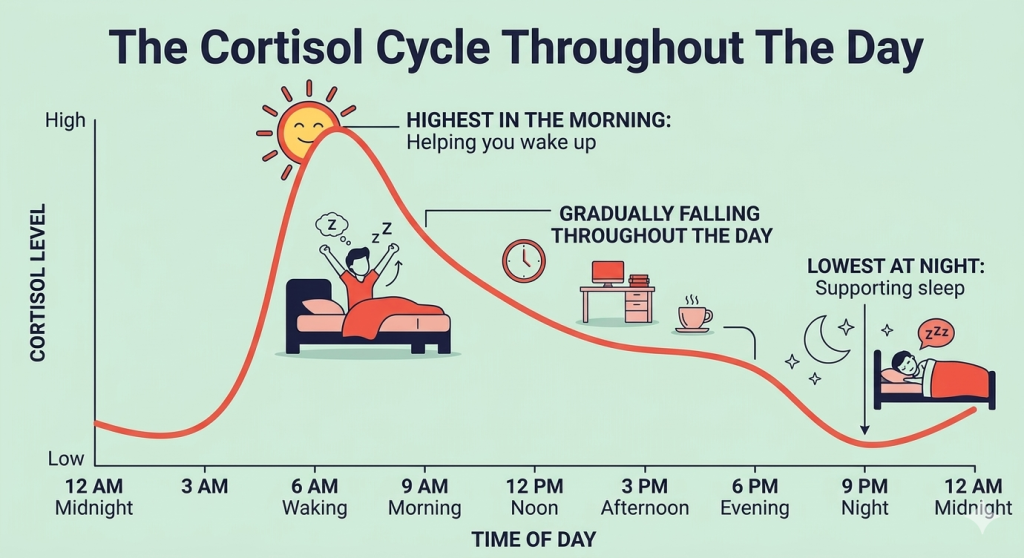
Cortisol and daily rhythms

Cortisol naturally rises and falls across the day:

This pattern works alongside other biological systems to regulate energy, mood and sleep. When it becomes disrupted, you may feel tired during the day and more alert at night, which can affect both physical and mental wellbeing.


The HPA axis

Cortisol is regulated by the hypothalamic–pituitary–adrenal (HPA) axis, the body’s central stress response system. It works as a feedback loop:

  • The brain (via the hypothalamus and pituitary) signals the adrenal glands to release cortisol
  • Cortisol helps you respond to stress
  • Signals are then sent to switch the system off

When this system is working well, it keeps stress responses balanced and short-lived.

Cortisol as part of a wider system

Cortisol does not act in isolation. It is part of a wider, interconnected system involving the brain, autonomic nervous system, immune system and behaviour.

Understanding stress therefore requires looking at how these systems interact, rather than focusing on cortisol alone.

What happens when stress goes on for too long?

Chronic stress does not simply mean “too much cortisol”. Rather, it alters how the stress system functions over time. This can involve prolonged responses, reduced feedback sensitivity, disrupted daily rhythms and, in some cases, blunted responses.

These patterns vary between individuals and can show up in different ways, including:

  • Prolonged responses to stress
  • Reduced sensitivity to feedback signals
  • Altered daily rhythms
  • Blunted or reduced responses 

Your body becomes less responsive

With continued stress, your body becomes less sensitive to cortisol’s signals. This is sometimes referred to as reduced glucocorticoid sensitivity. When this happens, the feedback system that normally switches off the stress response becomes less effective, meaning the body finds it harder to return to balance.

Inflammation can increase

Cortisol normally helps regulate inflammation. In the short term, it can reduce inflammatory activity.

However, with chronic stress, the immune system can become less responsive to cortisol. This has been associated with a gradual increase in low-level inflammation, which has been linked to some forms of depression, although this relationship is not consistent across all individuals.

Changes in brain chemistry

Chronic stress has been associated with changes in how the body processes tryptophan, an amino acid used to produce serotonin.

Under prolonged stress, more tryptophan may be diverted into the kynurenine pathway rather than being used to make serotonin. This may influence the availability of serotonin, although this varies across individuals and contexts.

Your body clock can shift

Stress often affects sleep and daily routines. Over time, this can disrupt your internal body clock, leading to:

  • Difficulty falling or staying asleep
  • Lower energy during the day
  • Further disruption to stress hormones

These effects can reinforce each other, creating a cycle that is hard to break.

How stress affects your brain

Stress doesn’t just affect your body – it affects how your brain works.

The hippocampus, which is important for memory and learning, can be affected by chronic stress. Chronic stress has been associated with reduced neurogenesis, particularly in the hippocampus. This may affect memory and concentration.

The prefrontal cortex helps you make decisions, stay focused and regulate emotions. Under chronic stress, this system becomes less efficient, making it harder to think clearly and manage emotions.

The amygdala, which detects threat, can become more reactive. This can lead to increased anxiety, feeling on edge and stronger emotional responses.

Chronic stress can also reduce levels of brain-derived neurotrophic factor (BDNF), which supports the brain’s ability to adapt and recover. This can make it harder to bounce back from stress.

Changes in mood and motivation

Stress also affects key brain chemicals involved in how you feel and behave.

It can influence:

  • Serotonin, which affects mood and sleep
  • Dopamine, which affects motivation and reward
  • Other signalling systems involved in focus and thinking

You might notice:

  • Reduced motivation
  • Less enjoyment in things you used to like
  • Feeling mentally “foggy”

Cortisol also plays a role in energy regulation, so when this system is disrupted, it can contribute to fatigue and reduced resilience.

The cycle of stress

One of the most important things to understand is that stress can create self-reinforcing cycles.

For example:
Stress disrupts sleep → poor sleep worsens stress regulation → low energy reduces activity → reduced activity affects mood.

Over time, these patterns can reinforce each other, making the cycle difficult to break.


Why people respond differently

Not everyone responds to stress in the same way. Differences can come from genetics, early life experiences, current environment and support or lifestyle factors.

This is why some people develop anxiety or depression under chronic stress, while others remain relatively resilient.

What you can do to support your stress system

The encouraging news is that your stress system is adaptable. Small, consistent changes can make a real difference, especially when they support the body’s natural rhythms and reduce ongoing strain on the system.

These approaches support stress regulation by stabilising biological rhythms, reducing system strain and improving recovery.

Support your sleep

Sleep plays a central role in regulating cortisol and the body’s internal clock (circadian rhythm). Poor or disrupted sleep is associated with higher cortisol levels, and over time this can create a cycle where stress and sleep reinforce each other.

You can support sleep by:

  • Keeping regular sleep and wake times (maintaining good sleep hygiene), even on weekends
  • Reducing light exposure at night, especially from screens
  • Creating a consistent wind-down routine

Sleep is one of the most powerful regulators of the stress system, and even small improvements can have a noticeable impact.

Move regularly

Physical activity helps regulate the stress response across multiple systems, including hormonal, inflammatory and brain pathways. Regular movement has been shown to:

  • Support healthier cortisol regulation
  • Reduce symptoms of anxiety and low mood
  • Improve sleep quality
  • Support brain health and neuroplasticity

This does not need to be intense to be effective. Activities such as walking, cycling and even gardening or housework can be effective. Consistency matters more than intensity.

Eat to support mental health

What you eat can influence stress regulation through effects on the brain, gut and immune system.

Diets that support mental health tend to:

  • Include a wide variety of plant-based foods, providing a range of micronutrients and fibre to support gut health
  • Include sources of healthy fats, such as omega-3 fatty acids
  • Contain key nutrients involved in brain function

Emerging research shows that gut health is linked to stress and mood through the gut–brain axis. Supporting a diverse and balanced gut microbiome may help regulate stress responses, including cortisol.

Some evidence-based approaches include:

  • Increasing dietary diversity, particularly plant foods
  • Including fermented foods such as kimchi or kefir
  • Consuming foods rich in polyphenols, such as fruits, vegetables and green tea

While no single food will “fix” stress, overall dietary patterns can play an important role in supporting resilience.

Maintain daily rhythm

Your body relies on consistent patterns to regulate cortisol and other biological systems.

Irregular routines, such as inconsistent sleep, eating at different times each day or limited daylight exposure, can disrupt these systems.

Supporting your daily rhythm includes:

  • Waking and sleeping at similar times
  • Eating meals at regular intervals
  • Getting exposure to natural light during the day

These habits help stabilise the body’s internal clock, which in turn supports mood, energy and stress regulation.

Manage ongoing stress where possible

Reducing sources of chronic stress can have a direct impact on how the body regulates cortisol.

This might include:

  • Making practical adjustments to workload or routines
  • Setting boundaries where possible
  • Seeking support from others or professional services

Psychological approaches, such as mindfulness or stress management techniques, may also help reduce the intensity and frequency of stress responses.

Stay connected

Social connection plays an important role in regulating stress.

Positive social interactions can:

  • Reduce stress reactivity
  • Support emotional regulation
  • Improve overall wellbeing

Even small, regular interactions can make a difference, particularly during periods of ongoing stress.

Conclusion

Cortisol plays an important role in keeping your body balanced and responsive. The problem is not cortisol itself, but how ongoing stress can disrupt the systems that regulate it.

These changes can affect your brain, your body and your behaviour. But they are not permanent.

Understanding what’s happening is the first step. From there, small, consistent changes can help your body regain balance over time, supporting improvements in mood, energy and resilience.

Where to get help

If you need further advice on supporting yourself or a young person with their mental health, take a look at the services below that can help.

Offers confidential advice and support for young people struggling with suicidal thoughts, as well as family and friends; and information about how to make a safety plan.

Its helpline service – HOPELINE247 – is available to anybody under the age of 35 experiencing suicidal thoughts, or anybody concerned that a young person could be thinking of suicide.

Opening times:24/7 every day of the year
0800 068 4141
Text: 88247

Whatever you’re going through, you can contact the Samaritans for support. N.B. This is a listening service and does not offer advice or intervention.

Opening times: 24/7
Text: 116123
jo@samaritans.org

Digital support community and charity offering information, peer support, facilitated listening circles, mentoring and courses for parents of children with mental health difficulties

Scroll to Top